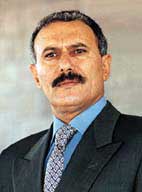
Ten years after unification, Yemen's President Ali Abdullah Saleh, has won the gamble that in 1978 seemed impossible, by reunifying his country, ending anarchy and chaos, redressing civil and military institutions, returning dignity to his people and winning respect for Yemen in the region and internationally.
Unity has been the dream of all Yemenis throughout history. But realizing this dream was not without pitfalls. In the late 1970s Yemen was in a perilous situation. It was a two-nation state, with a Marxist regime in the southern People's Democratic Republic of Yemen, and an Arab nationalist government in the northern Yemen Arab Republic.
On June 24, 1978, President Ahmed Al Ghashmi was assassinated by a briefcase bomb planted by the socialist party in Aden, South Yemen. The situation in North Yemen was also extremely precarious, where two presidents had been assassinated in less than a year.
Ali Abdullah Saleh, then a lieutenant colonel, was the military leader of Taiz governorate. He received a radio message saying that an explosion that had taken place at military headquarters in Sana'a and so flew there
.
When the plane landed in Sana'a, explains Saleh, "I was cautious because I had expected a coup d'etat and the airport to be under siege. Instead everything appeared normal.
"I decided to go on my own to a military camp near the airport. When I got there, I discovered 30 to 40 tanks heading towards the city."
Saleh knew the officer in charge. Unaware of the President's death, the officer told Saleh that the President's brother had ordered him to go to Sana'a and start shooting.
"I asked, 'who are you planning to shoot in Sana'a?" He did not know. He was simply following orders, said Saleh.
"Because of my good relationship with the tank corps, I was able to take charge and make my first decision to stop the tanks from entering Sana'a.
"One of the officers told me that there was an official meeting being held at the army headquarters. I was invited to attend."
Present at the meeting were the President of the People's Assembly Abdul Kiarim Al ?ط£آ§ط¢آ¹ط¹â€ک?ط£آ§أ¢â‚¬ع†ط·ع؛?ط£آ§أ¢â‚¬ع†ط¢آ½?ط£آ§أ¢â‚¬ع†ط¢آ½?ط£آ§أ¢â‚¬ع†ط·ع؛?ط£آ§أ¢â‚¬ع†ط¢آ½?ط£آ§أ¢â‚¬ع†ط¢آ½ط£آ§أ¢â‚¬â„¢ط¢آ½?ط£آ®ط¢آ«ط¹â€ ط£آ§ط¹ث†ط¹â€ ط£آ®ط¢آ¾ط¢آ¸ط£آ¯ط·ع؛ط¢آ£ط£آ®ط¢آ¦أ¢â‚¬إ“ط¸â€¦أ¢â€ڑآ¬ط·إ’ط£آ®ط¢آ¾ط¢آµط£آ§ط¹ث†ط¹â€ ط£آ®ط¢آ¦أ¢â‚¬إ“?ط£آ®ط¢آ¾ط¢آµط¸â€¦أ¢â€ڑآ¬ط·إ’ط£آ¯ط¸آ¾أ¢â‚¬â„¢ط¸â€¦أ¢â€ڑآ¬ط·إ’ط£آ¯ط¢آ¼ط¢آ´ط£آ®ط¢آ¾ط¹ط›ط£آ§ط¢آ¦ط¢آ³?ط£آ§ط¢آ«أ¢â‚¬آ¦?ط£آ§أ¢â‚¬ع†ط¢آ¼ط£آ§أ¢â‚¬â„¢ط¢آ½?ط£آ§ط¹ع©ط¢آ³?Arshi, Prime Minister Abdul Aziz Abdul Ghani, Army Chief of Staff Ali Shaybah and other top ranking Army staff.
Saleh learned of the president's death and recommended the presidency to Prime Minister Abdul Ghani, who declined it, as did other members, including Al Arshi.
They decided to create a Provisional Presidential Council (PPC) composed of Al-Arshi, who was to be acting president, Abdul Ghani, Ali Shaybah and Saleh.
The situation in Yemen was critical. Military movements were intensifying on the borders of North and South Yemen. A propaganda war was raging and police officers were pressuring Saleh to be the next president. They threatened to arrest all the members of the PPC and to mount a coup if he did not accept.
Saleh firmly argued against the coup, saying that the People's Assembly must choose the president.
This opportunity of a lifetime to fulfill his dream and the dreams of all Yemenis could also have been the end of Saleh's political career. Instead, it was to be the start of the lonely, long and difficult road to unifying his people and their country.
So the PPC was dissolved on July 17, 1978, and the Peoples' Assembly elected Saleh to be president and commander-in-chief of the Armed Forces, making it also the first time since the 1962 revolution that a head of state had been elected within a legal framework.
 |
| It took years of negotiations and agreements to achieve unity. |
Commenting on the events, "Newsweek" declared: "The new North Yemeni Head of State has six months at best".
This young, hesitant, 36-year-old officer of humble origins from a small village in the Sana'a Governorate, who had never been part of traditional circles of leadership, was facing an enormous challenge.
Eight months later, fighting broke out between North and South Yemen. South Yemen believed it was the right time to impose Socialist unity based on Marxist ideology. The South Yemeni army broke through the weak northern army and occupied Al Baida, Kaataba and Harib.
The conflict was short lived. The Arab League met in Kuwait on March 4, 1979, and ordered both sides to withdraw within ten days and respect each other's autonomy.
On March 30, 1979, Saleh, at the head of a North Yemen delegation, went to Kuwait for a meeting with his southern counterpart, Abdul Fattah Ismail and they agreed to set up committees to draft a constitution for the unified state.
 |
| Ali Abdullah Saleh signing the treaty of unity |
Saleh later appealed to Saudi Arabia for support to increase the North's military capability to match that of the South.
The Saudis approved funding after seeking American approval. (This was obtained after a report by the American Ambassador warned against the dangers of Marxist expansion into North Yemen, and possible threats on their interests in the region.)
However, because of training problems with the American weapons, Saleh chose to buy Soviet and Polish arms.
In the early 80s, terrorism and violence was at its peak. The National Front was planting mines and engaging in terrorism in the North. In November 1981, Saleh took the completed draft of the constitution for a unified state to Aden to propose unity once again. He said, " If unity is the answer to violence and terrorism, then so be it.
"But Saleh faced opposition from northern leaders, who interpreted his move as weak and an act of surrender to the communists. They were joined by some conservatives, encouraged by certain neighboring countries, who were hostile to southerners describing them as "Marxist atheists".
Unity was again rejected but several other agreements were reached: the creation of a High Supreme Council consisting of both state presidents; the return of Yemenis to their regions; the end to hostile military or political activities, and meetings were to be held between the presidents every four months.
During his visit, Saleh accompanied Ali Nasser to Hadramout, where he met Ali Salem Al Bidh, a leading socialist party member. Both interior ministers agreed to smooth the progress of the border crossing between North and South Yemen.
Recognizing the need for a strong political structure to fill the vacuum in the North, Saleh established The People's General Congress (PGC) in 1982, bringing together a number of underground parties, to present a united front to counter-balance the socialist party's Marxist ideology in the South.
The Supreme Yemeni Council held various short-lived meetings in Sana'a and Aden. The repeated cry for Unity caused friction within the political leadership of the socialist party and the army of South Yemen, which escalated into a bloody civil war in January 1986.
"Within three days of the confrontations, said Saleh, "I received a message from Nasser Mohammed thanking me for not getting involved. Six days later, however, he formally asked me to intervene, and in return, he would announce unity with me immediately. I refused."
The civil war ended when Ali Nasser Mohammed and several political and military leaders fled to the North, but some of his followers who wanted to carry out military operations in South Yemen, were prevented from doing so.
"We refused to make North Yemen a platform for the promotion of terrorism to the South, even though the socialist leaders in the South were applying the same policies by supporting the National Front against us."
By the time that Gorbachev came into power in Moscow, the situation and living standards in the North had improved: Oil had been discovered, the Marib Dam had been rebuilt; the armed forces were modernized; political life was more stable, and morale had improved.
The socialist leadership had traveled to Moscow to meet Mr. Gorbachev looking for support, prior to the perestroika. Gorbachev explained to them that the situation had changed and that the Soviet Union could no longer help.
Consequently, political speeches and media campaigns by the leadership of the South became more balanced in tone.
The people of the South had seen the development and political stability as well as the good foreign relations enjoyed by the North, where, in addition, conservatives who had violently opposed the South Yemen Marxist regime no longer regarded unity as "treason".
In April 1988, President Saleh and the socialist party Secretary General Ali Salem Al Bidh met in Taiz, and confirmed their commitment to the agreements made prior to January 1986.
The two leaders met again a month later in Sana'a, and recommended the opening of the borders between the two countries to further solidify unity.
"We considered the border crossing of Yemenis as the first nail in the coffin of separatism," said Saleh. "My biggest concern was making sure the people could move back and forth freely across the borders of the two countries. I wanted the prisoners of the south to come to the north to see their brothers here and to see the achievements accomplished, because the socialist party media was portraying the people of the north as primitive and tribal."
Freedom of movement between the two states, allowed the reuniting of families, and enabled southerners to buy commodities that had been unavailable under the socialist regime.
Saleh left for the south on November 30, 1989, to attend their Independence Day Celebrations with only one purpose - to obtain the approval of the draft constitution on a unified state by both parliaments. This draft constitution had caused major friction in the north, because its third paragraph failed to clearly declare the Islamic Sharia as the source of all constitutions.
"I knew the socialist party would not be sensitive to the demands made by the leadership in the north. My priority was the achievement of unity. As far as I was concerned, the constitution was not the Quran, and could, therefore, be changed at anytime.
"On my way to Aden, I stopped at Dhamar, Ibb and Taiz. I was received by huge crowds, whom I gave warm speeches to, telling them that the realization of unity was near, and that I will be visiting Aden to discuss with our brothers the arrangements necessary for unity. "
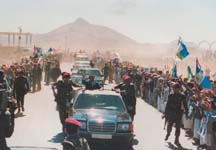
Saleh, recalling the memorable drive he took on November 29, 1989, from Taiz to Aden, said, "I was heading a big delegation of more than 100 citizens from all political and social affiliations from North and South Yemen. People lined all along that road, calling out for unity."
Saleh was received by the socialist party leadership at Karish checkpoint on the North/ South borders, and joined in one vehicle by Ali Al Bidh, Haidar al Attas and Salem Saleh on the way to Aden.
"The pressure on the socialist party leadership was becoming evident. When we entered Aden, I was greeting and waving to the public, whilst all three men accompanying me in the car remained silent. They were in shock to see the overwhelming support for unity."
"Immediately upon arrival, we commenced discussions on our proposal for unity, said Saleh. "The socialists straight away began to find hurdles. They claimed the Gulf countries, particularly Saudi Arabia, would never allow Yemeni unity, and would go as far as arranging the assassination of all those involved in the unification process, including myself.
"I said to the people: 'Unity must be accomplished at all cost, including our lives, and even if we only get to experience it for just a few days'." The next day a meeting was held at the socialist party headquarters. Saleh shocked party members when he disclosed the real purpose of his visit - to announce unity.
Saleh also threatened to resign and remain in Aden if unity was rejected. Al Bidh repeated the socialist party's fears for Saleh's life. He said if anything happened to Saleh, war could break out between North and South Yemen or their neighbors.
It was clear the socialists did not want unity, even though they were aware of the growing support for unity amongst the people.
During a private meeting later, Al Bidh emphasizing the difference between the population of the North - 12 million, and the South - 2 million, was concerned about the socialist leadership being replaced by former leader Ali Nasser Mohammed, once unity was certain.
Saleh also recommended the merger of the two governments, emphasizing there were three times as many government employees in the south as in the north. To attract the socialist party further, he offered them several key positions in the new government including the posts of vice-President, Prime Minister, Minister of Defense, and Minister of Oil. Finally, both men agreed to sign the united constitution and to refer it to parliament for approval.
Al Bidh called party members to an emergency meeting on the agreement. Tensions rose amongst the divided socialists, one member threatening to kill all present if the agreement was approved.
The historic agreement of Aden, as it came to be known, was finally signed on the eve of November 30 1989.
"When the people found out the unity agreement was signed, they went out on the streets of Yemen in parades bigger than weddings, full of excitement and joy," recalls Saleh.
Speaking to the people in Taiz the following day, Saleh asked them to forgive and forget the past. He said: "Unity does not imply a takeover; therefore, there can be no winners or losers."
Saleh was received by an overwhelming reception in Sana'a, with people carrying him on their shoulders through crowds of thousands.
At a press conference in Sana'a, on December 24, 1989, Ali Salem Al Bidh and Saleh agreed to have regular meetings on past agreements and constitutional amendments, and to organize a referendum on the constitution - once approved by parliament and the Shura council, and for the council of ministers of both countries to set up joint ministries and agencies, as well as new election laws. An amnesty was also issued to Yemenis previously involved in anti-unity activities.
In January 1990, the leadership of both governments agreed to give freedom of action to all political and social groups.
On January 22, 1989, Saleh was invited to the U.S. by President Bush. During discussions, Bush asked Saleh: "How can you achieve unity with the Marxists in the south who are enlisted as terrorists?"
Saleh replied: "I guarantee that all kinds of terrorism from the regime in South Yemen will end when we announce unity. But if we remain two separate countries I cannot guarantee the end of terrorism." He gained Bush's support and American commitment for unity in Yemen.
A meeting was held in Taiz between the two prime ministers, and decisions were made to merge public institutions, including the central banks and national airlines, as well as the customs, taxes, ports, communications, information, and telecommunication networks of the two countries. They also discussed the creation of a national emblem and the composing of an anthem.
An agreement between North and South was finally reached, and in Aden on May 22, 1990, Saleh raised the flag of the new Independent Republic of Yemen.
The Republic of Yemen was governed by a Presidential Council consisting of five members for a transitional period up to the first multi-party elections. The President and Vice-President were elected at their first meeting, and the parliament consisted of all the Shura Council members and the People's Assembly.
Some 98% of the voters in the May 15, 1991 referendum voted in favor of the constitution, the first article of which states "the Republic of Yemen is a sovereign and independent state. It is indivisible and inalienable. The Yemeni people are an integral part of the Arab nation and the Islamic world."
The October 1991 law encouraged more than 46 projects for the formation of parties and contributed to the electoral law bill approved on June 8, 1992, which established the principles of universal suffrage.
But things were not working out smoothly. Many of the country's financial problems had been inherited from the Marxist regime in the South, which had run up a bill of some .5 billion in arms purchases from the Soviet Union.
Angry with Yemen for its stance in the Gulf crisis, Saudi Arabia expelled more than a million workers, increasing the Yemeni population by eight percent and worsening the country's financial situation. Fate also added a dark period of floods, and droughts.
The elections were finally held on April 27, 1993, and were declared "free and fair" by international observers. The YSP came in third after the PGC and Islah. Despite losing, al-Bidh, who wanted to keep his party's posts and privileges, launched a vicious attack on the government, trying to stir up discontent against unity.
In May 1994, his followers launched attacks against government troops, and the army, encouraged and supported by the people, marched on Aden to safeguard unity and re-establish law and order.
On May 21, al-Bidh proclaimed himself president of the new Yemen Democratic Republic, and skeptical supporters started deserting. On July 7, 1994, the government announced an end to the rebellion, which had caused damage of some billion.
Al-Bidh fled to exile in Oman reportedly with several million dollars in cash.
So after years of conflicts, almost unending negotiations, promising rays of sunshine followed by dashed hopes, Yemen's people finally were united and now share in a democratic process unique in the Arabian Peninsula.
Unity has undeniably created a new atmosphere and mentality in Yemen bringing stability and economic growth. The introduction of a multi-party system and democratization could have been interpreted as a serious error in a country with no tradition of universal suffrage, challenged by problems of tribalism and religious conservatism and facing considerable interference from external and internal opposition.
Nevertheless, one of the world's oldest nations has been led by the determination, courage and persistence of its President, Ali Abdullah Saleh, towards a modern era where the brotherhood of traditional society will surely be a key factor in promoting peace and eventually economic prosperity.